This is our second summer with our geodesic dome greenhouse, and I’m doing something a little different this year. A common problem in small greenhouses is regulating the heat, either too much or, as is often the case in Alberta, too little. Thermal mass is a great way to do smooth out those fluctuations, and we have a large water tank that we use to help with it, and also small milk jugs full of water right next to plants to absorb heat during the day and release it at night. Last year, we had a crazy freeze happen in September, and I knew I needed to do more to store heat inside the greenhouse. One idea I had heard about is a Subterranean Heating and Cooling System.
Basically, a SHCS uses a fan to pump the hot, humid air inside a greenhouse underground through tubes that will use the soil as a big heat sink. During the day the hot air goes underground where it cools, transferring it’s heat to the soil, and when it exits the tubes the air functions as a cooling system inside the greenhouse. At night, the effect is the opposite; the air inside the greenhouse cools quickly, but the air coming out of the tubes in the ground will be warmer with the stored heat from earlier in the day. Here in our part of Alberta, even in the middle of summer, it isn’t uncommon to have night time temperatures around 10C or less and the air coming out of the SHCS should be warmer than that. Yes it is complicated, but the science is sound and I know it works. At least that is what I had to keep telling myself as I dug down 70 cm to bury the pipes! Whenever I tried to describe the system to someone they looked at me like I am crazy. As I was digging I wondered if I really was. Crazy.
If you want to see a thorough analysis of this kind of system complete with temperature graphs, here is one built in Scotland: www.permaculture.co.uk/sites/default/files/Solar_Greenhouse_Article_Web_Ed.pdf
Another advantage of this kind of system is that it will warm your soil up quicker in the Spring. Here are some observations reported in the above article:
“By March 21st the average greenhouse soil temperature at a depth of 76cm (30in) was 16° versus 6.5° in the soil outside, representing stored heat of around 49kW hours.”
Those are some pretty good results!
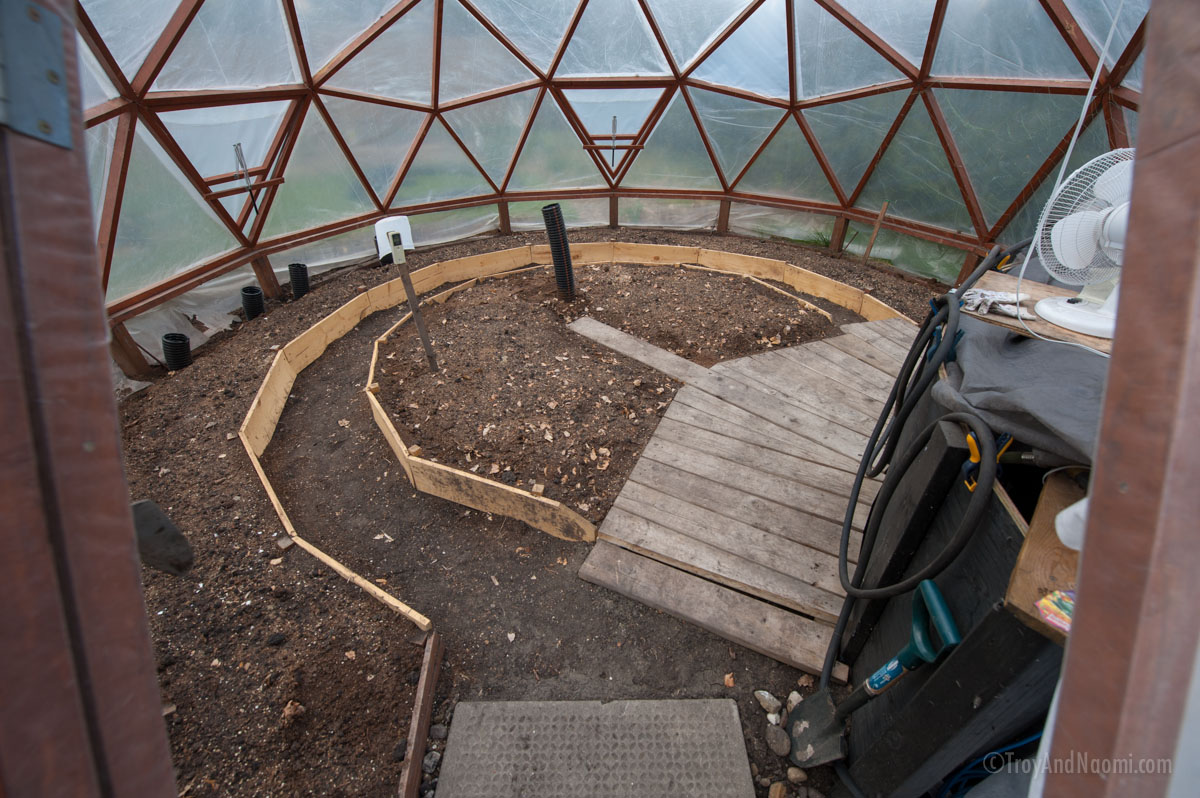
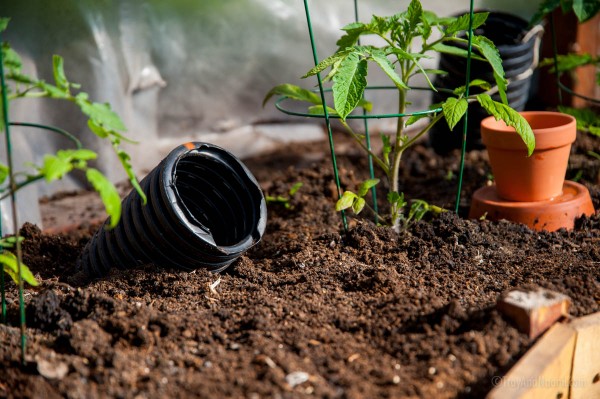
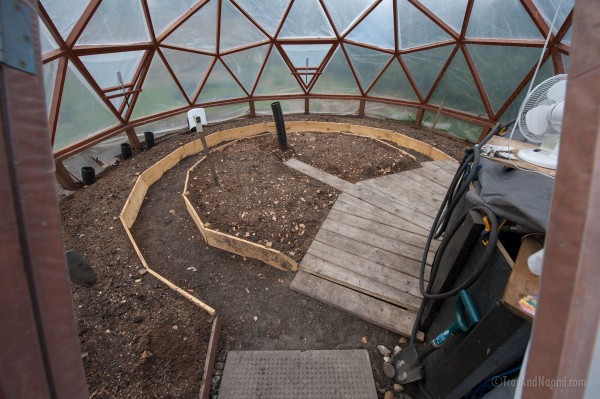
Given the circular shape of our greenhouse, and the fact that I didn’t want to dig up the whole thing down to that depth, I only used five tubes, two along each side of the outer ring of the greenhouse, and one coiling in the centre section.

Basic layout of the greenhouse

Where the tubes are buried
Digging down to 70 cm means I was past the rich, black soil and into the clay. I tried to keep the clay in one pile to pack back down around the tubes, but it inevitably got mixed in some with the other soil. The first two tubes I excavated all the soil and clay under the growing bed, but after that I just removed the soil and dug smaller trenches in the clay where I wanted the tubes as I was running out of space to pile the soil up.

lots of digging to get this far

Trenching

Andrew helped me dig the centre area

Centre section

The plenum, where the fan will blow down into the tubes
The completed system with the buried blue can, and a black can on top:
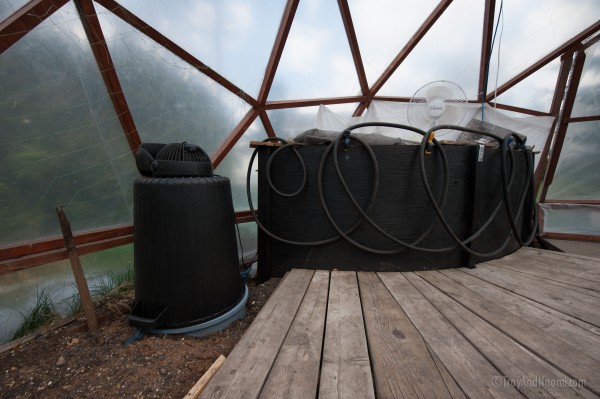
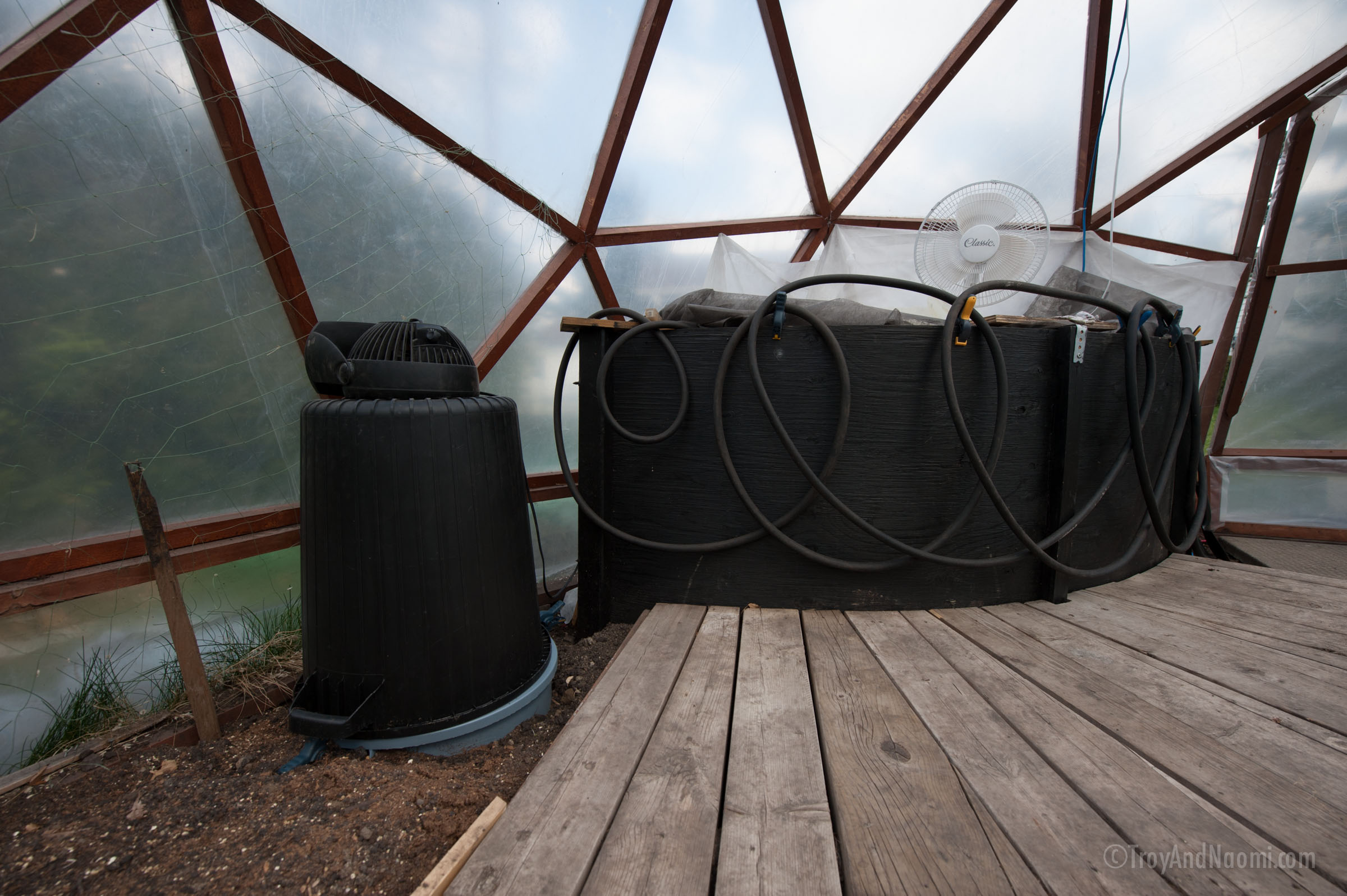
The fan is on top of a second garbage can to get it up higher into the warmer air. The black can will also absorb some heat on a sunny day which further heats the air as it goes underground. On day when the temperature was 23C (73F) outside, and inside the greenhouse it was 32C (90F), air coming out of the tubes was only about 16C (61F). The large black thing to the right is a water tank with loops of a black garden hose for the water filter. It also helps absorb some light energy and radiate it back at night.
There is a lot more I could have done for this project (insulate along the outside of the trenches, solar powered fans, more tubes, etc), but as this isn’t going to keep the greenhouse going in the winter in a 3a hardiness zone, and I was simply running out of time to dig. The five tubes will be enough for us. I’d like to add a temperature controlled switch for the fan, but for now it is simply on a timer.
We already had to rely on it one night as it got down to -3C (26F). Naomi took frost cloths and covered the plants, and the heat being pumped up from underground and blowing under the frost cloths kept everything warm enough. This should be a big help near the end of the growing season.
Fall Update:
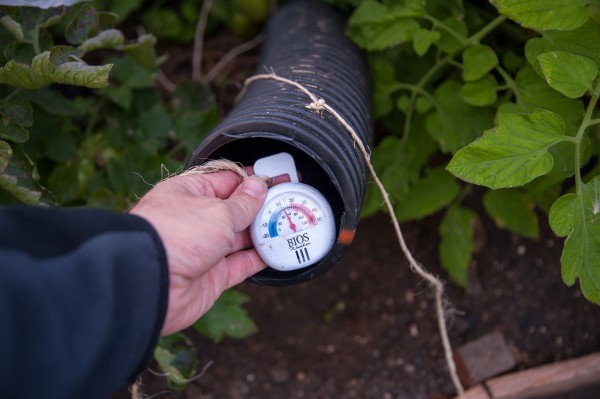
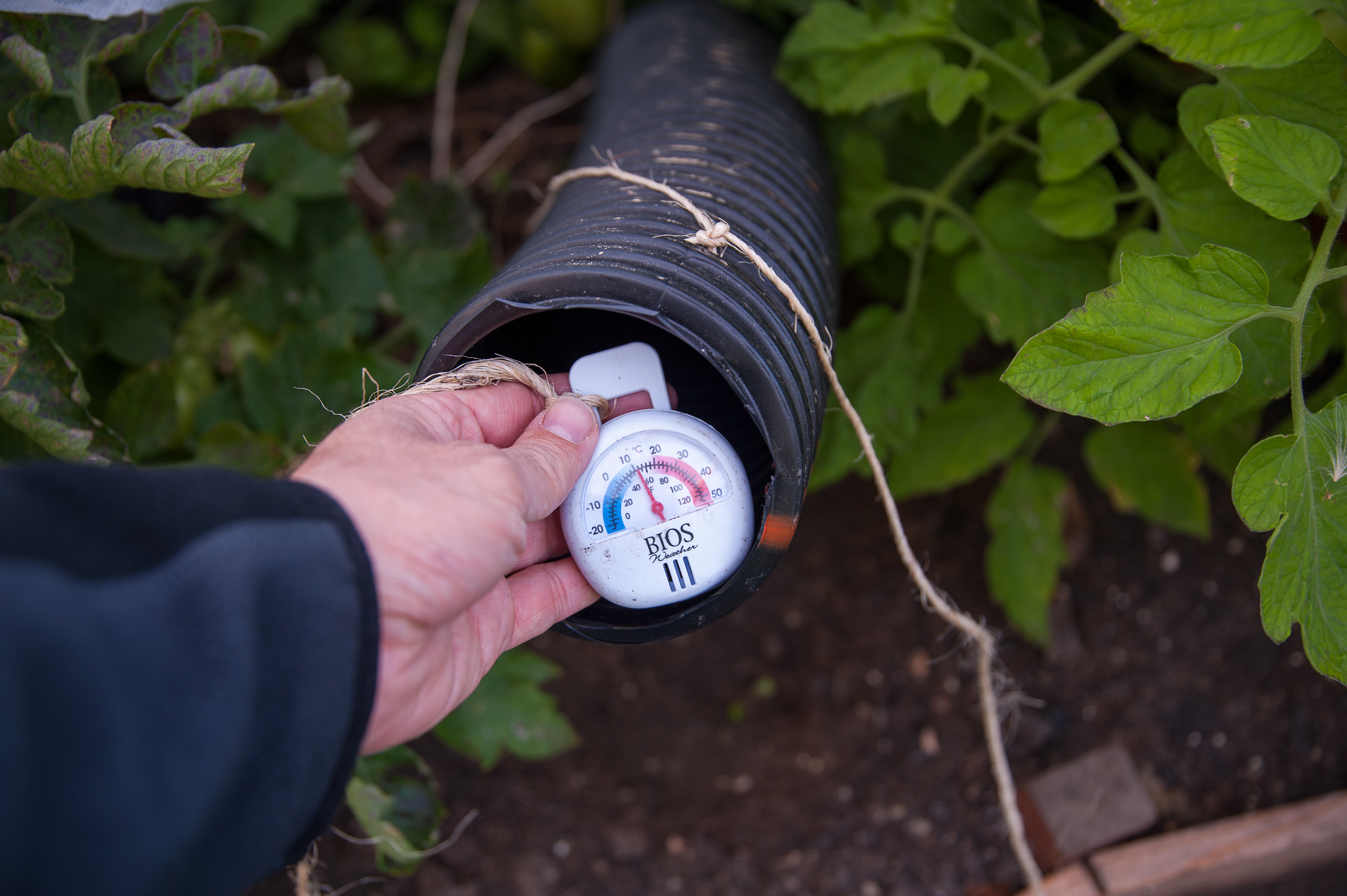
Early one September morning our outdoor thermometer said it was 0.8C outside. The greenhouse was 6.7C. The subterranean heating/cooling system was doing it’s job! I have a thermometer on a string that goes way down in one of the tubes. The air coming from underground this morning was still 10C.